Wednesday, October 31, 2007


Happy Halloween! I hope everyone has a fun and safe night. In my blog today I wanted to share with you my recent trip to a pick your own pumpkin patch in Lafayette, Colorado. It was a fun filled afternoon with friends, and as always, I found way too many pumpkins to bring home. I can never find just one - I like all the different shapes and sizes. I had a blast, and my puppy Harper Lee had a pretty good time, too. This is a picture of him and the pumpkin he "picked" out! Again, have fun and be safe! 

Tuesday, October 30, 2007

Valley of Fire


I missed my blog last week to take a Master Educator course in Valley of Fire State Park, so I thought I would take this opportunity to share some photos from my week. We had an eclectic crew, including BLM employees, non-profit representatives and several park rangers (one of whom was an Indians fan...notice the top picture, this was during the ALCS). Valley of Fire is located about 1 hr outside of Las Vegas and is characterized by large sandstone formations, many of which reveal signs of former residents (i.e. the Anazasi tribe, often referred to as the "Basketmakers.") Though "translations" of these petroglyphs reveal some insight into their culture and daily life, their true meanings are anybody's guess.  Due to the expertise of one of our instructors and the Chief of Operations for Nevada State Parks, Allen Newberry, we had the opportunity to view a unique petroglyph "the mythical batwoman." Unfortunately a lot of the native artwork has been defaced by visiting guests who want to add their own mark to the area. As a result, the park rangers have really strived to educate visitors on the principle of "Leave What You Find."  Anyway, Valley of Fire is a unique park, off the beaten path for many Nevada tourists, but definitely worth a visit if you are in the area.

Monday, October 29, 2007

Education in Action - and it works!!


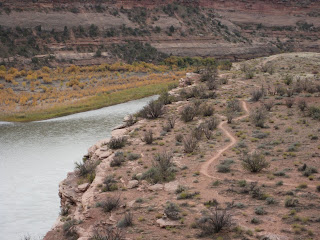
Another great fall weekend with friends mountain biking in Fruita, CO. To many mountain bikers, great single track is the holy grail of riding. And often the narrower the track, the better. Consistent efforts by the local bike shops, the International Mountain Biking Association and guide book publishers have led to an accepted code of conduct or ethics for mountain bikers.

One of the ideas is to keep single track single. When hiking it is easy to step off the trail onto a rock or some other durable surface to let others pass. When cycling you have the bike to deal with. And in the desert of western Colorado, you have very fragile soils. If a rider merely rides to one side, the trail is permanently widened. So dismounting, and moving to one side is strongly encouraged. On several loop trails in Fruita, they have gone a step further and posted direction of travel signs, to eliminate oncoming traffic.

Everyone one of us out there mountain biking this past weekend, enjoyed the fruits of this education. More incredible single track than we could possibly ride in a weekend. Now we just have to plan the next trip....

Friday, October 26, 2007

A Topic Worth Revisiting ...

A hot topic at several conferences I have attending this year and that also is the buzz in the outdoor industry is the issue of kids connection to the outdoors – or lack of connection to the outdoors. “Nature deficit disorder” is the term Richard Louv uses in his book, Last Child in the Woods. Many groups and individuals are working to tackle the issue including the Conservation Fund’s National Forum on Children and Nature , an assortment of groups that includes government, media and corporate partners. 

While I couldn’t agree more that this is an important issue, I also believe as efforts brew to get more kids active in the outdoors, it is imperative that an outdoor ethic message also be interwoven effectively in all efforts. What better time to introduce Leave No Trace to kids who are first experiencing the outdoors? What better opportunity to help shape these malleable value systems and help build leaders with the outdoor code of ethics we’re working so hard to foster? This is an issue we will actively pursue - more about this subject in the near future.

-Dana

Thursday, October 25, 2007

Part of Our World...

I can take anybody… anybody… in a game of Disney trivia. Seriously, fire away – I can answer any question about any Disney animated movie, starting with Bambi. Scene reenactments – you got ‘em. Musical renditions of just about any song – even better. I have even been known to interpretative dance to Lion King’s “Circle of Life” (which requires 2 other brave souls).

… By the way, I can’t believe I’m actually admitting this…

When I was a little girl, I used to play around in our neighborhood pool, crossing my legs at the ankles and flipping through the water. I would coast along the bottom of the pool, arrange my hair in front of my face, and then push up from the bottom – crashing through the surface and simultaneously flipping my hair back over my head, to my own Ariel-type symphony playing in my head.

Ariel was every girl's role model in 1989.

But in 2007? Imagine my surprise when, mid-elliptical session (I’ve since nixed the swimming), Ariel pops on to the page in Orion Magazine. One of my favorite publications, I always relish in its pages for thoughtful critique & insightful tidbits on our world. Thus, begging the question: Ariel?

Sure enough, in October 2006, Ariel became the leading lady for yet another epic – cleaning up our trashed seas. Though hardly animated, Ariel’s 21st century PSA has taken to both print and interactive media forms, teaming up with the National Marine Sanctuary Foundation, National Oceanic and Atmospheric Administration, Environmental Defense, and the Ad Council. The Oceans Awareness campaign even has its own interactive website, perfect for kids and adults alike. (Check it out!)

So, how is the princess fairing with her interactive features and clamshell bikini? Especially considering, as the contributor so delicately puts, “the oceans are screwed beyond belief?

The answer lies in our ability not to underestimate the power of a little Disney magic in the hearts of little-ones! If not her, who will tell our children of our endangered oceans? As Ben called in to question on Monday, who will be the next generation of caretakers & supporters for our world if not the kids?

Luckily the author comes around, and I’d like to share this feel good note for what it’s worth. “I’d cast my vote,” he says, “for Hans Christian Andersen’s little mermaid, the one who knew something about danger, suffering, sacrifice and redemption.” Not only does she aim for world love, she fought for immortality through sacrifice, pain, and love. “Her hard-knock story makes her a half-human creature to reckon with.”

The future generations are the key to preserving our natural lands & waters. If it takes a beautiful mermaid, a French crab, and a plush fish to do it, then what do we as adults have to loose by using a little imagination?

Wednesday, October 24, 2007

Leave No Trace Around the World


I am, by no means, a jet-setter.  However, I have managed to travel a bit internationally, and have loved my experiences abroad.  A few stops in Latin America, Europe and Africa have certainly given me perspective and enriched my life overall.  

Often times, when I am abroad (which never seems to be frequently enough) I think about the ways Leave No Trace outdoor ethics are already incorporated into other cultures.  Whether it's a "No Littering" sign on a trail in the Costa Rican cloud forest or the push to reduce the consumption of plastic bags in Kenya, there are people everywhere making ethical decisions to maintain the integrity of our planet.  
Photo taken in Santa Elena Reserve, Costa Rica.

Photo taken in Nzulezo, Ghana.

Just because a formal Leave No Trace program may not exist, Leave No Trace principles are applicable in every setting:  on the trail, in the market and in your own home - regardless of where you live.  There are folks around the world using Leave No Trace outdoor ethics in their schools, on guided trips, and in their parks.  We have partners in India, Korea, Ireland, Fiji, Tanzania and Argentina.  

There is an overwhelming tendency to limit Leave No Trace outdoor ethics to the backcountry of the United States; but the fact is, Leave No Trace could be (and many would argue should be) part of your daily life, no matter where you live.  What do you think?  How do you "Leave No Trace?"  I wanna know!

Tuesday, October 23, 2007

One Night on Bainbridge

On a recent trip to the Northwest, I went to a reading and book signing by Washington Congressman Jay Inslee. Inslee, a member of the House Natural Resource Committee, just wrote a new book, Apollo’s Fire, about building a clean energy economy in the United States and I the world. After the talk, reading and questions, the conversation inevitably shifted from energy to conservation.

The crowd of 200 that packed into Bainbridge Island’s Eagle Harbor Book Company talked values and ethics as they relate to the environment. Even Inslee commented that the transition from discussions of clean energy to conservation values often occur in his public forums.

The best part: This audience was genuine, engaged and informed. I was curiously overwhelmed with a sense that all was not lost. At least this group of people on this night could make relevant connections among their personal outdoor and environmental ethics, the ethics of their community and their natural environment. It was exhilarating.

-Susy

Monday, October 22, 2007

Where are all the kids?

I was recently looking at visitation statistics* for lands managed by the National Park Service and noticed an alarming trend - numbers of visitors to our nations national parks, national recreation areas, national seashores, etc. have been on the decline since the late 90's:

1997: 275,236,335
1998: 286,762,265
1999: 287,130,879
2000: 285,891,275
2001: 279,873,926
2002: 277,299,880
2003: 266,099,641
2004: 276,908,337
2005: 273,488,751
2006: 272,623,980

*Data from Public Use Statistics Office of the NPS


While some may view this as welcome relief for our sometimes overused national park lands, I view it as part of a larger problems that we're experiencing - less and less people are being exposed to the wonders of the out-of-doors. Why is this a concern? It's a concern because it begs the question of who will be the next generation of supporters of national parks and other public lands. As you've no doubt heard, there has been a great emphasis placed on getting more kids outside. The book Last Child in the Woods by Richard Louv sparked much action to combat what he termed nature deficit disorder. Many of the federal land management agencies have programs such as the Bureau of Land Management's Take It Outside program. There are also many web-based resources such as the Children and Nature Network which are specifically trying to provide more opportunities for children to get out and experience the out-of-doors.

With all the increased emphasis on getting kids outside, Leave No Trace certainly has a role to play. More people on the land means more opportunities for impact. However, it also mean more opportunities for education! If every kid who experiences the out-of-doors were introduced to Leave No Trace, think what the future of our shared lands would look like. While it saddens me greatly to think that we've become so technologically advanced that our kids our now suffering from nature deficit disorder, I do find great hope in the fact that steps, BIG steps, are being taken to expose our youth to all that nature has to offer.

Monday, October 15, 2007

Graffiti - arghhhh!

What bugs you more than anything else out on the trail?  Is it trash, loud groups or individuals, or cell phones in use?  Here in Boulder we can now add graffiti to that potential list of aggravators.  For the first time ever, I saw paint-pen graffiti on rocks while out hiking and running.  Not just once, but twice on different trails!  Somehow in my mind these were mutually exclusive interests.  Looks like I was wrong.

Then to really emphasize the issue, someone added their graffiti to Leave No Trace's shared office building!!!!!


Thursday, October 11, 2007

When the whole world smiles at you

1,133 New Membership T-shirts that I ordered

14 large boxes 

45 lbs. per box

1 bad decision to leave work early on the arrival day of 630 lb. delivery

1 Clogged door leading to my office.

1 Smily face drawn in Sharpie, on the outer most box of this 3 deep x 4 high barricade...

PRICELESS.


Lesson: 5 months in to your new job is not too late to be the recipient of a "new girl" prank!

Wednesday, October 10, 2007

Lions, Tigers and Bears Oh My!

The past week has been full of wildlife sightings for me as I've hiked various trails around Boulder with my dog. Over the lat 6 days, I've managed to see a couple of deer, a fox, an owl and three bears. You probably weren't that impressed until you got to the bear part. I know, I wasn't either. But bears! 

Photo courtesy of Boulder Daily Camera Newspaper.

Last Thursday morning, as I hiked along one of my favorite trails, I saw a sow and 2 cubs about 200 yards away. It was an amazing experience for me, as I had just been saying that I had never seen a bear in the "wild" before. I immediately leashed Oliver (the dog) and continued up the trail, careful to observe the sow's behavior. Both parties seemed content to see each other and amble on our respective routes.  I was mindful the entire time to keep my distance and kept thinking about the Leave No Trace principle "Respect Wildlife." 

The next day, I read an article in our local newspaper about a sow and two cubs hanging out in a Boulder yard.  While I can't be certain that it's the same bear family, I think there's a very good chance it is.  Their presence in the North Boulder neighborhood caused quite a stir, and many folks hung out all day watching the bear's activity, despite the requests of the Colorado Division of Wildlife officers.  Leave No Trace isn't just applicable in the backcountry, but also in your (neighbor's) front yard, too.


Tuesday, October 9, 2007

My Dear Deer


This dirty, pretty soul was sitting in the neighbor’s yard the other day. My husband mowed the lawn, the dog barked, and the buck didn’t move for over an hour until he casually skipped the back fence, hunching to avoid the trees.

A couple of years ago, a similar looking buck peered into our front window on Christmas morning to the delight of our family and visitors. Every spring since, the neighborhood deer eat my tulips, scratch more bark off of my aspen trees, nap with their babes in my day lilies. Each year, the number of deer in our neighborhood eerily grows. The problem with this picture is that I live in downtown Boulder, Colorado.

Driving to work now, I have this false sense that the neighborhood deer and I have an unutterable understanding. We stare into each others’ eyes. I release my foot from the accelerator. They stomp the curb with their hooves. Someday they’ll prove that me wrong.

Though oddly thrilling, still, to have wildlife so close to home, my discomfort grows daily as the numbers of these misplaced animals do.

-Susy

Monday, October 8, 2007

Fall Fly Fishing in the Rockies

In Colorado we're blessed with miles and miles of streams and rivers full of trout. I've been exploring some of those miles of water this fall and have been rewarded with beautiful days and fish – browns, rainbows, brookies and cutthroats. Fly fishing is a great way to enjoy the outdoors because it allows you to truly immerse yourself in nature by standing in cold moving water, feeling the breeze and waiting for fish to rise to your fly. For me, there is nothing quite like it. I don't get too concerned about the size of the fish or how many I catch, I just like being on the water. Because I fish alone much of the time, I carry a camera so I can 'bring my catch home' with me. It's always nice to share fish stories, especially when you have the photos to prove that the big one didn't get away. Every catch is different, every fish is different and each situation invokes its own unique memories that can last a lifetime. Have fun out there, be safe and Leave No Trace...

Thursday, October 4, 2007

Change through the Arts

Throughout history art has been a vehicle for change. The Harlem Renaissance in New York City led by Langston Hughes, Richard Wright, Billie Holiday, and Dizzy Gillespie challenged white paternalism and racism. These artists and intellectuals rejected imitating the styles of Europeans and white Americans and instead celebrated their own identity, dignity, and creativity. The Harlem Renaissance would lay the foundation for the Civil Rights Movement, thus bringing about change through their art. 

The Velvet Revolution, a six week period in 1989 in Czechoslovakia was a bloodless revolution that saw the overthrow of the socialist government there. It was led by Vaclav Havel, a writer and playwright, and many other students of the arts. Their peaceful demonstrations and underground work inspired 750,000 people to demonstrate on two days in November, 1989 and would inspire a nation to go on strike against the socialist government. Their work brought about change for their country peacefully.

Recently, we have seen changes that need to be made within our environment to stop global warming, help conserve our natural resources, save our wilderness areas, and help improve our carbon footprint. Again, art is a vehicle that is being used to bring about these changes. Fed have not seen Al Gore's "An Inconvenient Truth", a documentary that sparked concern in our country concerning global warming. This popular film tells real truths about our environment and has kindled Americans thinking about global warming.

However, Al Gore is not the only person to use an art form to communicate changes that need to be made. Of late I have seen more evidence of artists working to bring about change. On npr.com, a website that I frequently visit, I have seen recent stories of change through art. David Buckland, an artist, started the Cape Farewell Project. Buckland, along with other artists, has made three expeditions to the Arctic to bring back personal stories about global warming. Buckland wanted to help scientists communicate what they were finding about global warming, using abstract concepts we can now see, hear, and read their work from the arctic.

Another recent article on npr.com highlighted the "Cool Globes: Hot Ideas for a Cooler Planet", a public art project in Chicago. The Cool Globes exhibit is designed to inspire individuals and organizations to take action against global warming. Artists from around the world used a variety of materials to turn plain, white spheres into sculpted globes. Check out the article on npr.com and see for yourself these spectacular globes and the changes they are inspiring people to make. 

Change happens in a variety of ways, but the arts can inspire everyone. Using art as a vehicle for change in our world today is a real concept that everyone can get behind! Check out the artists and exhibits above and see how you can get involved in your own community, city, and state!

Tuesday, October 2, 2007

Yay Fall!


Personally, fall is my favorite time of year! I think it is the time when I most love being outdoors, enjoying the cool air, the beautiful fall foliage and, of course, carving pumpkins. Every part of the country has it's own unique fall "traditions" whether it's driving up to the mountains to view aspens, apple-picking on a beautiful farm, or attending a local october festival. So, while you are out and about celebrating the change of seasons, remember that many others are doing the same and try your best to "leave no trace." Happy October!

Inclusiveness

What does this word mean today in our changing society? My colleague, Sara Close and I attended a conference last week determined to find out. The conference, jointly sponsored by the Denver Foundation and the Community Resource Center, was an all day seminar that included more than 200 attendees and a huge variety of non-profits interested in the ideas of inclusiveness (check out the entire inclusiveness movement here. What we learned is that we have a lot to learn.

For a number of years, we at Leave No Trace touted the fact that we were an “all inclusive” program. We worked with many different partners (even corporate competitors) and we were a program that included hikers, climbers, mountain bikers, boaters, bird watchers and any other group who enjoys the outdoors. Our definition of inclusiveness did not, however, call out specific races, ethnic backgrounds, etc. I would not say that these groups were in anyway excluded, but they were not specifically identified ¬– until somewhat recently, that is. In the past few years, we have been reaching out more and more, creating programs and materials for diverse cultural and ethnic groups. But in many ways, and the conference confirmed this point, we are just learning.

This endeavor for inclusiveness is not an easy one. Anyone involved in the outdoor industry knows it is generally not a diverse bunch. There is, in fact, a lack of diversity on many levels from participation to employment. But I believe the industry is also very aware of this problem and am hopeful that change is coming. Leave No Trace has started the uphill climb and is committed to becoming more inclusive. We can and will make an impact on as many diverse communities as possible. Through our work for inclusiveness, perhaps we will begin to see that change so needed in the outdoor demographic. As the conference stressed many times, it might be a challenging, lifetime journey, but inclusiveness in the long run will be worth every step.