Showing posts with label geocaching. Show all posts

Wednesday, June 16, 2010

Caching In At Kettletown

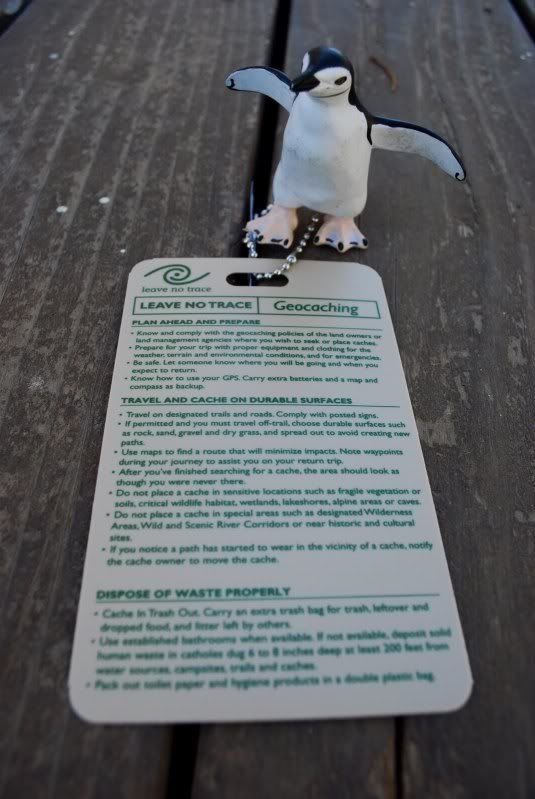
The eighth annual Geo Jamboree was held under rainy skies this past weekend in Southbury, CT. The rain could not deter the crowd of nearly 250 geocache enthusiasts from hitting the trails. With more than 35 caches in the park, Kettletown State Park was an ideal location for the event. The Leave No Trace Center for Outdoor Ethics' latest reference hang tag provides minimum impact techniques to practice while geocaching. Click here if you are interested in purchasing a geocaching hang tag for your own personal use.

During the month of June, the first challenge of the Bigfoot Challenge is to bring and extra bag on your next outing and pick up any trash you find on the trail. Many of the folks we signed up for the Bigfoot Challenge reported that "Cache In, Trash Out" was their mantra and they didn't need to challenge themselves to do it, they were already practicing it! In the photo above, a kayaking geocacher takes the Bigfoot Challenge.
We were pleased to be a part of the Jamboree again this year and be able to share ways the geocaching community can practice Leave No Trace during all of their future outings.
Happy Adventuring...Kate and Tracy

Wednesday, May 12, 2010

Road Wisdom: Geocaching


According to geocache.com, “Geocaching is a high-tech treasure hunting game played throughout the world by adventure seekers equipped with GPS devices. The basic idea is to locate hidden containers, called geocaches, outdoors and then share your experiences online. Geocaching is enjoyed by people from all age groups, with a strong sense of community and support for the environment.”

Currently there are over 1 million registered caches worldwide! As we travel the country, teaching the skills and ethics of Leave No Trace, we encounter many different schools of thought on this up-and-coming activity, which is celebrating its 10th anniversary this month.

Some people feel strongly that geocaching bridges the gap for people that enjoy technological activities with being on an outdoor adventure in a natural setting. Other people feel that some geocachers miss a majority of the outdoor experience because they are so focused on the technology piece that they are driven into the wilderness only to put all of their energy into finding the coordinates. Yet another group feels that geocaching brings individuals and families together by getting them out of their living rooms and into the great outdoors. What is your opinion?

Regardless of each person’s motive to join the geocache movement, Leave No Trace has developed a reference hang tag (available in our online store) to promote responsible recreation practices while geocaching. Here are some points to consider:
  • Plan properly for your geocaching outing by having the items or equipment you'll need to safely enjoy your adventure. Also, if placing a cache, make sure it's legal in your area.
  • Be conscious of where caches are placed (choose durable surfaces) and think about how traveling to and from a cache can cause trampling, erosion, etc.
  • Have the necessary knowledge/equipment to deal with trash, litter and human waste.
  • Consider the impacts of geocaching to both plants and animals.
  • Be mindful of other visitors who may also be enjoying the same areas as you.
If you would like to weigh in on your opinion of geocaching, email kateandtracy@lnt.org and we will post comments on an upcoming blog!

Happy Geocaching,
Kate and Tracy

Tuesday, March 9, 2010

GPS Units determine geological effects of Chilean earthquake

In an interesting merge of nature and technology researchers from Ohio State were able to determine the geological effects of the February 27th earthquake in Chile using GPS units.

GPS measurements before and after the earthquake revealed that the town of Conception, the epicenter, moved nearly 10 ft to the west, while the larger city of Santiago moved over a foot.

For more information, please refer to this article: Chilean Earthquake

Historically used for scientific purposes, GPS units are a hot topic in the outdoor recreation world, with the increasing number of people worldwide participating in the activity of geocaching - similar to a treasure hunt - by which participants find caches based on GPS coordinates. Sometimes these caches are man-made, sometimes they are nature-based (a beautiful waterfall for example).

Thousands of caches are found in cities worldwide; an interesting (and peripheral) effect of a natural event like an earthquake, would be the shifting of these published geocaching coordinates.

For more information about geocaching, visit: http://www.geocaching.com/

The Leave No Trace Center for Outdoor Ethics recently began publishing educational materials that promote responsible enjoyment of this activity. For more information, please contact us.

Monday, February 8, 2010

Geocache in Outer Space?


By now you've surely heard of geocaching. Talk about exponential growth - there are now over 982,000 active caches worldwide. According to http://www.geocaching.com, geocaching is "a high-tech treasure hunting game played throughout the world by adventure seekers equipped with GPS devices. The basic idea is to locate hidden containers, called geocaches, outdoors and then share your experiences online. Geocaching is enjoyed by people from all age groups, with a strong sense of community and support for the environment."

With the explosive growth in geocaching, it was just a matter of time before a cache would be placed in outer space. Read more here.

The Center has been actively reach out to geocachers about adopting Leave No Trace practices when they're placing and seeking caches. One of the newest educational resources is the Geocaching Ethics Reference Card. This pocket sized resource has the right information to help you Leave No Trace on your next geocaching adventure.

Sunday, October 18, 2009

Geocaching 101: Part Deux


This morning we said our goodbyes to our recent travel companion, Wolfgang Von Pitterpat. As promised in our earlier post Geocaching 101…We Need Your Help, we dropped Wolfgang off at the first suggested location, the Travel Bug Hotel (N 36° 30.306 W 104° 55.241) in Cimarron, New Mexico. Before dropping Wolfgang off we tagged him with our newest ethics reference card on geocaching*. This being our first adventure into the world of geocaching, we weren’t sure what to expect. Turns out we had a lot of fun and finally took the time to learn how to use the GPS unit that has been sitting in our glove box for over a year! Here is a brief retrospective of our geocaching adventure...enjoy!

We found Wolfgang at the top of Boundary Peak in Nevada and decided to make him an honorary Traveling Trainer!

Wolfgang perched on the Subaru on our way to Cimarron.

JD and Wolfgang figuring out how to use our GPS unit.

We found the "Travel Bug Hotel" right next to the historic St. James Hotel, which is supposedly haunted!

*No Travel Bugs were harmed in the tagging process.

Wednesday, October 14, 2009

Geocaching 101…We Need Your Help!

In honor of the new Leave No Trace ethics reference card on Geocaching, we decided to pick up a travel bug on a recent hike on Boundary Peak in Nevada. He’s pretty cute and we’re having a tough time deciding where to bid farewell to our new traveling companion, so we thought we’d ask for a little help.

Here is a list of places we are going to be visiting in the next few weeks, first person to leave a comment with coordinates of a cache in the general area of one of these events decides the fate of our little friend!
• Outdoor Adventure Summit – Philmont, NM
• Subaru Ready for Adventure Event – Malibu Creek State Park, CA
• Leave No Trace Center for Outdoor Ethics – Boulder, CO

Wednesday, September 16, 2009

New Geocaching Reference Cards

For all you geocachers out there, we now have reference tags that will help you learn and teach others how to leave no trace when searching for and placing caches. Geocaching is a great way to explore places you may not have visited before and to reacquaint yourself with more familiar territories you walk by every day.

Geocaching evolved from a centuries-old activity known as letterboxing, in which participants search for logbooks in secret locations and leave messages. Geocaching is letterboxing for the digital age, involving the use of a GPS to hide and seek outdoor objects. The objects (trinkets, logbooks) vary from place to place and are usually placed in waterproof containers out of view. To learn more about geocaching and to get started by reading some clues, visit the geocaching website.

If you would like to order our new geocaching reference cards, visit our store. Remember, members and partners receive a 10% discount on the purchase of educational materials.

Tuesday, June 16, 2009

Geo Jamboree 7


We spent a fun and soggy weekend at GC1K21P (that’s Kettletown State Park in Southbury, CT for all you geo-caching novices) for Geo Jamboree 7. With 44 caches, it was not surprising that almost 300 geo-caching enthusiasts took part in the 2-day event. In addition to hunting down caches (several of which required boats and rappel gear to reach) there was camping, live music and some pretty serious cuisine! We had a great time and want to give a special “THANK YOU” the CT A-Team (Walt, Ian, and Chris) for sharing their camp with us, for feeding us some amazing “camp food” and for keeping up company.

Happy geo-hunting!

Emily Ressler and JD Tanner
Subaru/Leave No Trace Traveling Trainers-Team East

Monday, April 27, 2009

Have you heard of Letterboxing?


Want to get the family out, but not sure where to go or what to do? Check out Letterboxing.org for some easy fun. Use the search feature in the bottom right to find letterboxes in your area. Essentially very similar to Geocaching, but without the technology. Letterboxes are found by deciphering riddles, puzzles and other clues. Some folks have spent an amazing amount of time creating fantastic searches.

Our family spent a good portion of the day Sunday searching for several local letterboxes. We were not 100% successful, but we had 100% Fun! Also numerous "teachable moments" presented themselves for passing on Leave No Trace knowledge to the whole family.

An excerpt from one stash:
"From the downstream end of the railing count back 54 rungs, including the smallest rails. ...jump down over the tiny wall. At this spot there is a loose rock in the wall. Remove it to find ..."

Tuesday, April 21, 2009

Mistaken Geocache


This kind of thing is happening more and more these days. Be sure you know the rules and regulations for geocaching in your area before placing a cache...

For Immediate Release
April 20, 2009
 
Suspicious package at Fairview determined to be a geocaching device

City of Boulder Police are on scene at Fairview High School after receiving a report of a suspicious package outside the school at 1515 Greenbriar Blvd. All students and staff have evacuated the building and are safe. The suspicious package has been cleared and determined to be a geocaching device.
 
The incident happened at about 11:40 a.m. when a teacher noticed a man and a woman burying some kind of box near the stone sign in front of the school. When they finished burying the box, the suspects drove away. The suspects are described as a middle-aged male and female driving a cream-colored SUV with Nebraska license plates. Police have put out an alert on the vehicle.
 
When officers arrived, they determined that the school should be evacuated and called for the bomb squad. The bomb squad has determined that the box was a geocaching device, not a bomb. The bomb squad is still checking two backpacks that were left abandoned inside the school.
 
All students were relocated to Southern Hills Middle School, 1500 Knox Drive. Fairview High School has been closed for the rest of the day. District officials have notified other schools in the area.
 
This investigation is continuing, and criminal charges are likely.


Monday, March 31, 2008

Geocaching

By now, I'm sure you've heard of geocaching. According to http://www.geocaching.com/, geocaching "is an entertaining adventure game for gps (global positioning system) users.


The basic idea is to have individuals and organizations set up caches all over the world and share the locations of these caches on the internet. GPS users can then use the location coordinates to find the caches. Once found, a cache may provide the visitor with a wide variety of rewards. All the visitor is asked to do is if they get something they should try to leave something for the cache.

Over the past several years, geocaching has grown by leaps and bounds. Started in 2000, there are now more than 540,700 active caches worldwide. To put the growth in perspective, there were 340,000 active caches by December 2006. In less than two years, the total number of caches worldwide has almost doubled.

Geocaching presents an interesting set of issues with respect to Leave No Trace. First, there is the fact that many, many people are getting out and enjoying the out-of-doors. Second, many of them are the new generation of tech-savvy youngsters who otherwise might choose the Wii over a hike outside. Third, there is the cumulative impact of all these cache hunters on the landscape. With such a large number of caches, there is the potential for significant impact to the land. Trampling impacts, wildlife impacts, human waste impacts, trash, litter, off-trail travel, etc. are all part of the equation.

However, if those participating in geocaching can strive to minimize their impact, either those seeking or placing caches, then every geocacher can enjoy the outdoors in a responsible way. 

Things to consider:
  • Properly planning for your geocaching outing by having the items or equipment you'll need to safely enjoy your adventure. Also, if placing a cache, making sure it's legal in your area. 
  • Being conscience of where caches are placed (durable surfaces) and thinking about how traveling to and from a cache can cause trampling, erosion, etc. 
  • Having the necessary knowledge/equipment to deal with trash, litter and human waste. 
  • Considering impacts of geocaching to both plants and animals. 
  • Being mindful of other visitors who may also be enjoying the same areas as you. 
As always, get out, enjoy the outdoors responsibly and Leave No Trace...