Tuesday, May 22, 2012


Tuesday, May 8, 2012
One of 10,000
 |
| Bears were on the loose |
 |
| Students exploring why they make the decisions they do |
The students got to learn about all seven principles through discussions, games, and demonstrations. Coming from a variety of different outdoor experience levels, it was great to introduce them to everything from cat holes and human waste disposal issues to using a campstove to cook dinner. Throughout the day, the concept of Leave No Trace as a personal ethic and mindset weaved its way throughout each discussion. For the capstone of the day, they explored the considerations that go into their own decision making both in the outdoors and in the rest of their lives. During the activity, the students evaluated different factors in their decision making processes and considered why they do what they do. As they make individual decisions both in backcountry travel and everyday life, we hope they take what they learned from this activity with them!
 |
| Beautiful Lake Bemidji |
On the Paul Bunyan Trail,
Quinn & Frank
Sunday, May 6, 2012
Minnesota Summertime
 |
| A Minnesota Sunset |
- Wear great boots -- Trails between lakes are, because of the fact that they go between lakes, much more likely to be muddy than usual trails. So make sure you have great boots so you can tromp right through that mud and protect the vegetation and habitat on either side of the trail.
- Don't crash into shoreline -- Give both the landing and your boat a break by wet-foot portaging. In this technique, you slow the boat and use your feet to stop it before it crashes into rocks and landing, avoiding damaging them and keeping from making that big old crashing sound. Hop out in the water to unload the boat and throw it up on your shoulders for that hike over.
- Check fire regulations -- Just because your around water doesn't mean you can get careless with your fire building. When you set off on a backcountry paddle, check the current fire regulations before you go and keep them in mind throughout the trek. If you start with a fire ban on your permit, it's a fire ban throughout your trip even if it rains or weather conditions change.
- Check your boat for invasive species -- Just like it's important to clean your boots before a backpacking trip, if you're moving your boat from one area to another you should check it for invasive species. Check in with boat permitting offices for the most up-to-date information about invasives and stop aquatic hitchhikers!
Paddle or Portage?
Quinn & Frank
Wednesday, May 2, 2012
Bigfoot On Base
 |
| Bigfoot with Scouts at Minot Air Force Base! |
We had an awesome time with this group and think that everyone learned a lot about Leave No Trace. Without question, we loved our time being on base and wanted to thank all of these Air Force families for their service to our country! We want to thank the Air Force for welcoming the e-tour onto the base, it was a privilege to visit and share the Leave No Trace principles with the Scouting community on base. Thank you for all that you do, and we can't wait to get back up to North Dakota for another great event!
From the Barracks to the Backcountry,
Quinn & Frank
Monday, April 30, 2012
Open Places are Great Spaces
 |
| Little Missouri River in Theodore Roosevelt National Park |
 |
| Buffalo in Theodore Roosevelt National Park |
On a Buffalo,
Quinn & Frank
Thursday, April 26, 2012
Leave No Trace Education Near You - Where to find the Traveling Trainers in MAY

Want to host the Subaru/Leave No Trace Traveling Trainers for an event? REQUEST A VISIT FROM THE TRAVELING TRAINERS!
Team East May Calendar
Team West May Calendar
E-tour May Calendar
California:
- Craft Brewers Conference - San Diego
- Cuyamaca Rancho State Park - Descanso
- Conservation Camp - Buena Vista
- Clean Up Green Up - Salida
- Camp Chief Ouray - Winterpark
- Hot Spot Outreach and Backyard Session - Buena Vista
- SOS Outreach - Avon
- Grand Trunk - Chicago
- Hi-Cone - Chicago
- REI Lincoln Park - Chicago
Massachusetts:
- The North Face Role Model - Peabody
- Girl Scouts - Douglas
- Youth Leader Training - Bemidji
- S.A.L.T 'Mines & Pines' - Crosby
- Cuyuna Range Elementary School - Crosby
- YMCA - St. Croix
- Simley High School - Inver Grove Heights
- Minnesota Master Naturalist Conference - Mankato
- Rampano Valley District Northern New Jersey BSA - Oakland
- Cub Scout Pack 53 - Fords
- The North Face Endurance Challenge - Bear Mountain
- Boy Scout Troop 49 - Valley Falls
- Coleman Factory Outlet - Lake George
- Devils Run State Park - Devils Run
Skills - Propane/Natural Gas Canister Disposal
Spring is in the air; time to start planning trips, sorting gear, and possibly, replacing old equipment. But what are you supposed to do with those old, empty (and partially full) gas canisters for your stove? It's not always as easy as tossing it into the trash. Here are some things to know when disposing of old gas canisters:
- Most fuel canisters are steel and can be recycled along with your Dr Pepper cans. Just burn off any residual fuel and puncture empty canisters before recycling. Crushing empty cans with big rocks seems to work well. Note: Make sure canister is completely empty before puncture!
- Coleman, which makes Powermax aluminum fuel canisters, used to manufacture a "Green Key" puncture tool with compatible stoves. While no longer produced, this key is still effective at discharging residual fuel in canisters. However, JetBoil has produced a similar tool called the "Crunchit" that simultaneously vents the remaining fuel and punctures the can for recycling. The "Crunchit" can be used any any fuel canister, not just JetBoil! Here's a video...
- In Boulder, Burlington, and other eco-conscious towns, you can just toss empty, punctured canisters into your recycle bin. In Seattle, canisters that are empty (and marked as such with a Sharpie or adhesive label) can be placed in curbside recycling bins–no puncture holes necessary.
- Call your local Public Works Department and ask about rules in your area.
- Additionally, http://earth911.com/ is a very useful website for finding disposal facilities in your area. Simply enter you location and search for "propane tanks", "fuel canisters", etc.
Leave No Trace Backyard Sessions - April
April Backyard Sessions
In 2011 the Leave No Trace Center for Outdoor Ethics introduced a new social activism and environmental stewardship campaign called Backyard Sessions. Backyard Sessions take many forms, but most of all they bring together and activate local communities to incorporate Leave No Trace into all of the ways we live and play.
The Center has been working closely with various organizations to implement Backyard Sessions into existing service projects across the country. Pennsylvania State Parks has come forward with a myriad of projects slated for 2012 and the Center is currently collaborating with these parks across Pennsylvania to incorporate Leave No Trace education and outreach in their service projects. While many will take place throughout the year, below are the opportunities, both in and outside Pennsylvania, scheduled for April.
- 4/23/12 - Trash clean-up at Shining Mountain School in Boulder, CO
- 4/27/12 - Arbor Day tree planting at Tyler State Park in Newtown, PA
- 4/26-28/12 - Volunteer Clean Up Weekend at Ole Bull State Park in Cross Fork, PA
- 4/28/12 - Knotweed Knockdown at Oil Creek State Park in Oil City, PA
- 4/28/12 Step Out and Volunteer Event at Hills Creek State Park in Wellsboro, PA
- 4/28/12 Tree Planting day at Knzua Bridge State Park in Johnsonburg, PA
Backyard Sessions hope to inspire volunteerism and motivate people to get more involved with Leave No Trace education and action at the local level.
CALL TO ACTION: The Center wants you to organize a Backyard Session in your Community. Your role as a Leave No Trace volunteer and educator to help organize Backyard Sessions to teach people about Leave No Trace is critical!
Your valuable assistance is now needed in 2 key ways:
CALL TO ACTION: The Center wants you to organize a Backyard Session in your Community. Your role as a Leave No Trace volunteer and educator to help organize Backyard Sessions to teach people about Leave No Trace is critical!
Your valuable assistance is now needed in 2 key ways:
- Mobilize your network of Leave No Trace supporters, youth groups, schools or others to organize your own outing at a trailhead. Provide a 20-minute introduction to Leave No Trace and then hit the trail with trash bags and gloves for an easy clean up. Look for “Leave No Trace teachable moments” along the way. Tell us about it!
- Identify and attend outdoor and environmental events in your community and offer a 5-30 minute introduction to Leave No Trace concepts.Whether this is with a small crew at a trailhead on a trail-related service project, with volunteers at a river clean up, a youth event or with a group of multi-day backpackers, we’d like you to locate opportunities in your area (preferably in a natural setting) to help spread Leave No Trace skills and ethics. And one last step: Tell us about it!
Call (303.442.8222 ext.107) or email Jason Grubb, Education Programs Coordinator, for more details on how you can get involved!
Southeast Send Off!
All over AR. For the past three months, we have traveled all over the Southeast providing outreach and workshops to more than 25 schools, universities, organizations, and land management agencies. All though Arkansas expands our reach to just west of the Mississippi River, we experienced some creative groups that are benefiting from the Leave No Trace Program. We spent three days at Lake Dardanelle State Park, which provides interpretive programs to visitors at the park. Take a look at the photo below: The park rents out backpacks for families looking for interesting and educational activities to fill their time while at the lake. Notice the Leave No Trace hang tag attached to the pack!

 |
| Jennifer Hazelrigs and Scott Dirksen-Lyon College were excited to see Bigfoot come out for the Saturday morning trail run! |
 |
| We led a three hour skills workshop, with a surprise guest! |
Horseshoe Canyon had many goats, horses, dogs, and mules that call the Ranch home. We were shocked to have two horses join us at our workshop, first time for that! This would not be the last time we see horses this week...
 |
| Tracy, Jacque, Kate and Rob in Snowball, AR. |
We finished up our time in Arkansas on horseback! We spent the day with Rob Stephens, BSA/Leave No Trace all around champion, and Jacque Alexander, Leave No Trace/Backcountry Horseman of America advocate, as well as other members of BCH of Arkansas for a trail ride along the Buffalo River National Park. 15 miles later, we enjoyed river crossings, wildflowers in bloom, and riding along the painted bluffs, all the while making friends with everyone including "Dakota and Shorty". Thank you to Jacque, Rob, and all of the ladies on the ride. Oh what a day-Glorious!
As we head towards the Northeast, we reflect on all of our events the past few months since the 2012 season began and look forward with great anticipation for the next three months in the Northeast!
Respect the Resource...Kate and Tracy
Wednesday, April 25, 2012
Responses to the April Situation
Here’s the Situation:
While camped in an area that does not allow collection of wood for fuel, you notice people a few campsites over dragging large logs to their fire ring. It's getting dark and the temperature is dropping, but the campsite host that typically sells firewood isn't around and the wood is locked up. While driving in, you noticed another campsite host a few miles up the road. What do you do?
What you said:
Head over to their campsite, introduce myself, invite them to hang out with us at our campsite without a fire, but good company. Maybe get into talking about why they might not be allowed to collect wood if it seems appropriate.
–Eric Raslich
Go up the road to the other campsite host or better yet skip a fire for the night and use a stove to cook!
–Dustin Hall
Use the Tranger to cook food as food warms you up more than a hot drink.
–Sara Griffin
Walk over and suggest that they cook dinner and warm up with a stove and not a fire along with our campers and then suggest warming up with an active game of dark hide and seek (marco polo style for those of you who have never played hide and seek in the dark)
--Debbie Todd
What our Subaru/Leave No Trace Traveling Trainers said:
The first step is to walk past their campsite, stop to say hello, maybe comment on the changing weather, and then ask if they’ve eaten dinner yet. If they have not, ask them if they plan to use the fire to cook dinner. Then, if you have sufficient fuel remaining, you can offer your camp stove to help them prepare a warm meal before the temperature drops too much. While offering you can mention that the ban on collecting wood for fuel protects the scarce resources of the area, possibly for wildlife habit. If they have eaten, and are building the fire for more social purposes or warmth, you can direct them to the other campsite host farther up the road to purchase wood or to a possible campfire alternative. Maybe you can offer them your stargazing chart to be an alternative activity. Again, it is important to remind them of the reasons for the ban on collecting firewood. Often, this occurs in canyons with scarce dead wood that can be used by animals for habitat or for nutrient recycling and decomposition. Its always great to check in with the local management agency to be sure what kind of fire regulations there might be in your area before you head out on your overnight trip and if the folks around you forgot to check before they left you can be their helpful resource.
Earth Week in Colorado!
Starting on Earth Day on Sunday in Nederland, the e-tour has been spreading the word about Leave No Trace all over Colorado for Earth Week! It's been a truly beautiful location to talk about environmental stewardship to audiences ranging from interested citizens in Boulder County to high schoolers set on making a difference to elementary school students getting outside for the first time!
To kick off the week, we headed up to the Wild Bear Mountain Ecology Center where we joined with other conservation-minded organizations for an Earth Day Celebration! It was awesome to get to talk to youth and adults alike about the outdoors with the Rocky Mountains towering over us. From outdoor enthusiasts excited to learn about new reference cards for Winter Use and Rock Climbing to kids learning the PEAK principles, everyone took home some new information to help make good decisions in the outdoors. Not only that, but our Colorado State Advocate Kristin and famous mascot Bigfoot also were able to make the event!
The next morning, we scrambled over to the Shining Mountain School in Boulder where we got to talk with some high school students before they scattered about town to help out with keeping this beautiful area clean. With this dialed group, we got to focus on the reasons why Leave No Trace is an ethic -- not a set of rules, but a series of personal values and selected responsibilities about how to be a good citizen not of the state or country but of the planet. In addition to cleaning up around their school and community, these students are challenging themselves to take responsibility for the trash that they generate on a daily basis by packing out what they pack in to school just like you would in the backcountry. In this fashion, they become aware of what they are using each and every day and can strive as individuals to minimize their overall impact. We were inspired to get to speak with such dedicated students!
Finally, with a little help from our good friend Bigfoot we got to visit elementary school students both in Boulder and Colorado Springs! The kindergarteners in Boulder got to share some of their favorite activities in the outdoors by drawing pictures for each other. By getting out and connecting with nature, these students are forming the foundations for a life of conservation. The fifth graders in Colorado Springs drilled into a lot of the science behind what happens to trash. They asked the tough questions about the difference between natural products and plastic, recycling and composting, and the effect you can have on animals by carelessly discarding food waste. We're confident that they will take this enthusiasm and inquisitive mindset with them as they head out into the world and start making their own decisions about the actions they take and the impacts they make. Great work Wildflower Wildcats!
Everyday is Earth Day,
Quinn & Frank
 |
| Bigfoot at Wild Bear! |
 |
| Quinn and Bigfoot at Earth Day in Nederland, CO! |
The next morning, we scrambled over to the Shining Mountain School in Boulder where we got to talk with some high school students before they scattered about town to help out with keeping this beautiful area clean. With this dialed group, we got to focus on the reasons why Leave No Trace is an ethic -- not a set of rules, but a series of personal values and selected responsibilities about how to be a good citizen not of the state or country but of the planet. In addition to cleaning up around their school and community, these students are challenging themselves to take responsibility for the trash that they generate on a daily basis by packing out what they pack in to school just like you would in the backcountry. In this fashion, they become aware of what they are using each and every day and can strive as individuals to minimize their overall impact. We were inspired to get to speak with such dedicated students!
 |
| Traveling Trainer Frank with his college friend and now elementary school teacher Mr. Gamble at Wildflower Elementary! |
Everyday is Earth Day,
Quinn & Frank
Monday, April 23, 2012
Lunch Spot of the Week
 |
| Can you spot Kate? |
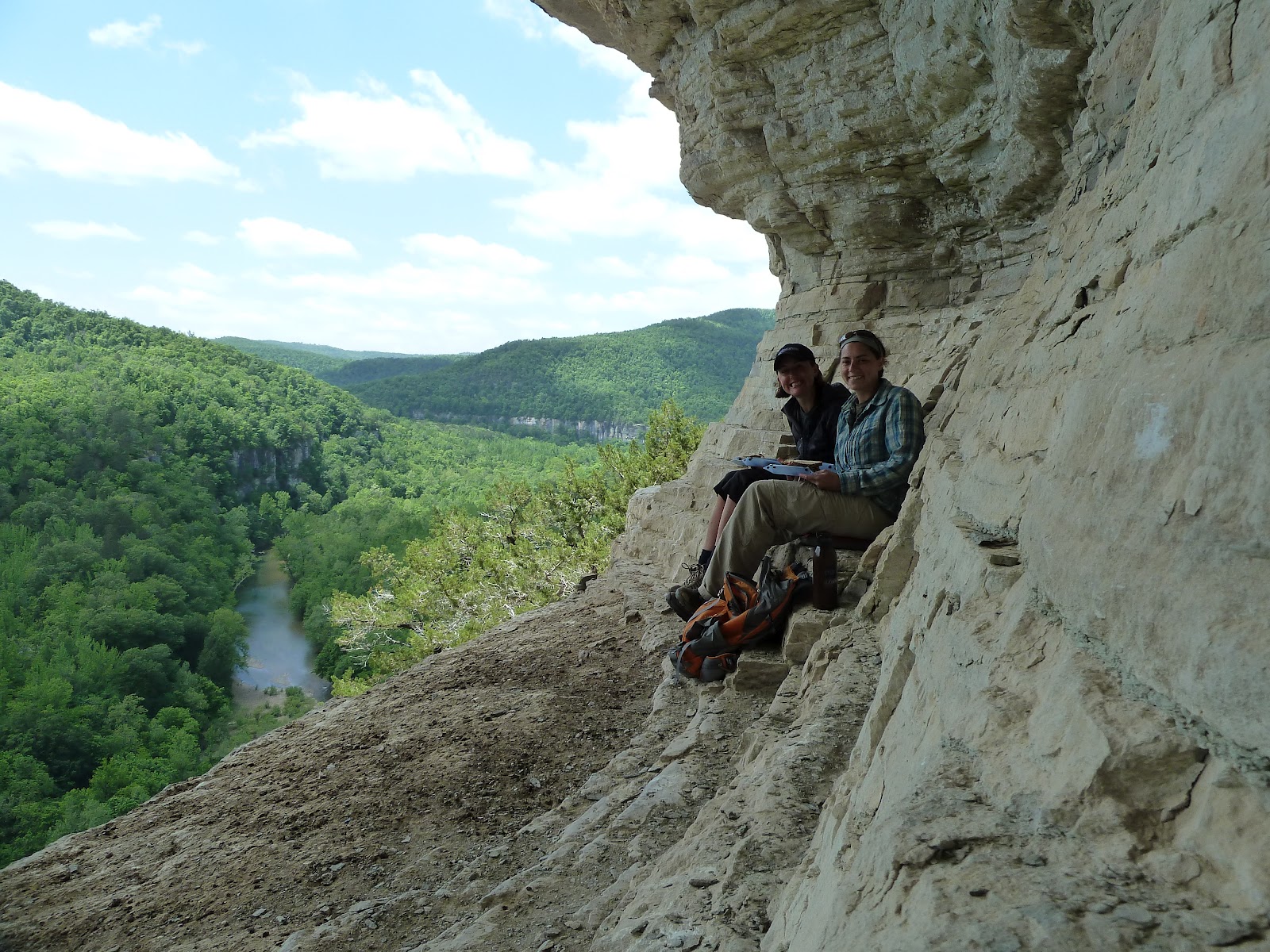 |
| The Goat Trail over looking the Buffalo River.
Respect the Resource...Kate and Tracy
|
Friday, April 20, 2012
Yearning for Higher Learning
San Bernardino Area, CA:

This week Team West had the pleasure of spending time with two extremely active student recreation programs. We spent Tuesday at Pomona College with their Outdoor Education Center staff and adventuring members. Thursday we joined CSU San Bernardino's Recreational Sports department for another set of campus outreach and workshops.

Listening to, and talking with these student driven groups our hopes are that these outgoing members will take up the charge of getting fellow classmates out of doors and practicing Leave No Trace. These recreation programs will provide access to gear and excursions that would otherwise be out of reach either monetarily or logistically. The chance to sea-kayak, rock climb, backpack, paddle-board or bike in an encouraging peer filled environment is a perfect place to foster a blossoming outdoor ethic. Leading by example these groups have the power to show hundreds of students each year that the Seven Principles of Leave No Trace help provide for a better outdoor experience for everyone. Not only on a burly expedition, but from the dorm room to the campus quad too.
Recreate your recreation.
Mark and Tara
Wednesday, April 18, 2012
Monday, April 16, 2012
Leave No Trace - Dolores River Training

This is a guest blog by Jay Loschert, Dolores River Stewardship Assistant for American Whitewater
American Whitewater and Lower Dolores Boating Advocates recently sponsored a Leave No Trace Awareness Workshop on March 31 in Dolores, Colorado. Nine whitewater enthusiasts from the Four Corners area joined Rick Ryan, retired Bureau of Land Management river ranger and Leave No Trace Master Educator for a fun and informative day. Volunteer stewardship activities such as this provide excellent opportunities for AW’s members and affiliate clubs to demonstrate leadership in river protection efforts.

Various hands-on activities reinforced the 7 Leave No Trace principles for western river corridors. Rick did a fabulous job of leading discussions about how they apply specifically to the Dolores River. Of particular concern on the Dolores is the protection of archaeological sites and rock art panels. We also learned how pet owners can help minimize the impacts of their animals. Because the river season is so short, social impacts are often concentrated and crowding can be an issue. Participants shared their own stories and suggestions for addressing these problems. As one volunteer put it, “What really made an impression on me were the exercises Rick involved us in to really help us see how different the same scenario can look through different eyes.”

The highlight of the day was Rick’s demonstration of his movable fire pan system. This drove home the point to many of us that leaving no trace provides pragmatic solutions for camping issues, while protecting the resource at the same time. And the banana boats we cooked in the coals sealed the deal! Thoroughly dousing the fire and straining the coals for proper disposal wrapped up the demonstration. Other activities reinforced the need for good river kitchen practices and proper sanitation.

Participants concluded the day with a discussion of effective ways to share what they learned with others. By communicating our passion for the wild, unspoiled nature of the river canyon, we can gently remind others of the rationale for leaving no trace. We all have stories of how a river trip or canyon hike left an indelible mark on us; drawing out stories from other visitors creates a starting point for discussions about our individual and cumulative impacts.

This project was designed to assist the BLM in managing the river corridor for whitewater recreation. The Tres Rios field office no longer funds a river ranger position, so it is up to the boating community to educate others and ourselves about using the resource responsibly. River stewardship begins at home. Phase 2 of this project will involve outreach to other whitewater enthusiasts at boat launch sites this spring and at the Dolores River Festival on June 2. Who knows, we might even break out the fire pan and make some banana boats!

Sunday, April 15, 2012
A Snowy Saddle Day!
 |
| Riding a bike through Grand Teton National Park! |
From October through the end of April, the Teton Park Road in Grand Teton National Park is closed to non-motorized vehicles. During most of that time, it's groomed for Nordic skiing as snow covers the entire area. In the spring, though, bicyclists get to rule the road. In the quiet and uncrowded park, you have to leave your car at the gate and power your own recreation down the road to catch spectacular views of some of the most remarkable mountains in the world. The Leave No Trace e-tour stopped by the park and enjoyed all it had to offer on wheels. It's also a great way to really connect with nature and Be Considerate to Other Visitors by helping let nature's sounds prevail. And when you visit in off-peak seasons, not only do you get to see parks from a unique perspective but it's a great way to help lessen your impact on crowding, wildlife, and the outdoors! So get on your bicycles and head outside!
Let Them Ride Bikes,
Quinn & Frank
Friday, April 13, 2012
Leapin' Lizards!


San Elijo Lagoon Nature Center, Cardiff-by-the-Sea, CA:
Last week Team West spent a few hours with Park Rangers from all over the County of San Diego. The collective will be returning to their individual parks and sites with strategies and tactics of how to best connect the messages of Leave No Trace into their visitors' experiences. Getting together with this many rangers and sharing their personal struggles and successes in the challenging task of leading park guests toward their own sense of stewardship is an awesome venue for teaching and learning Leave No Trace.
After our training we snatched the opportunity to stroll the paths at the San Elijo Lagoon Nature Center. Contrasting its proximity to some major roads and development the lagoon is an absolute oasis of life. A short walk revealed shore birds, waders, ducks, spiders, hummingbirds, and flowers. By far the most obvious form of animal life were the scores of lizards sunning themselves in the sweet Southern California sun.
Recreate your recreation.
Mark and Tara
Thursday, April 12, 2012
The Natural State of Arkansas Tech and Beyond
 |
| Wildflowers abound in Arkansas |
Russellville, AR. Team East spent the past two days working with students and faculty at Arkansas Tech University. An educational partner of Leave No Trace, Arkansas Tech strives to promote Leave No Trace within the Department of Parks, Recreation, and Hospitality Administration. Nestled in the western part of Arkansas, Russellville is within close proximity to many beautiful lakes, forests, waterfalls, caverns, and mountains. The "Natural State" truly offers outdoor enthusiasts the opportunity to enjoy natures playground. Students at Arkansas Tech can access the Ozark National Forest, Hot Springs National Park, numerous Army Corp of Engineer waterways such as Lake Dardanelle, the Buffalo National River Wilderness, along with numerous state parks including Mount Magazine- the highest point between the Appalachian Mountains and the Rocky Mountains.
 |
| Bulletin Board at Arkansas Tech |
We thank Dr. Glen Bishop for bringing the Traveling Trainer Program to Arkansas Tech! His enthusiasm for protecting the "Natural State" is contagious and we are very excited to explore what this area has to offer.
We will be at Lake Dardanelle State Park all weekend providing training opportunities for the staff, outreach to the public, and evening campfire programs both Friday and Saturday nights! Come on down!
Respect the Resource...Kate & Tracy
Wednesday, April 11, 2012
Mr. Foot Goes to Middle School
 |
| Bigfoot with 6th Grade Science Teacher Ms. Pieper!! |
Seeking the 'Squatch,
Quinn & Frank
Monday, April 9, 2012
And The Crowd Goes Wild!!!
Have you ever witnessed a user created shortcut along trail switchbacks? While these additional trails may look harmless, unnecessary erosion occurs, thereby damaging the actual trail. In addition, vegetation alongside the trail, which may be home to sensitive wildlife habitats including plants and animals, gets trampled as the trail is widened. Leave No Trace recommends to avoid cutting trail switchbacks as you travel along the established trail.
 |
| Going up! The trail goes to the right, the shortcut to the left. |
Respect the Resource...Kate and Tracy
Subscribe to:
Posts (Atom)


 Posts


